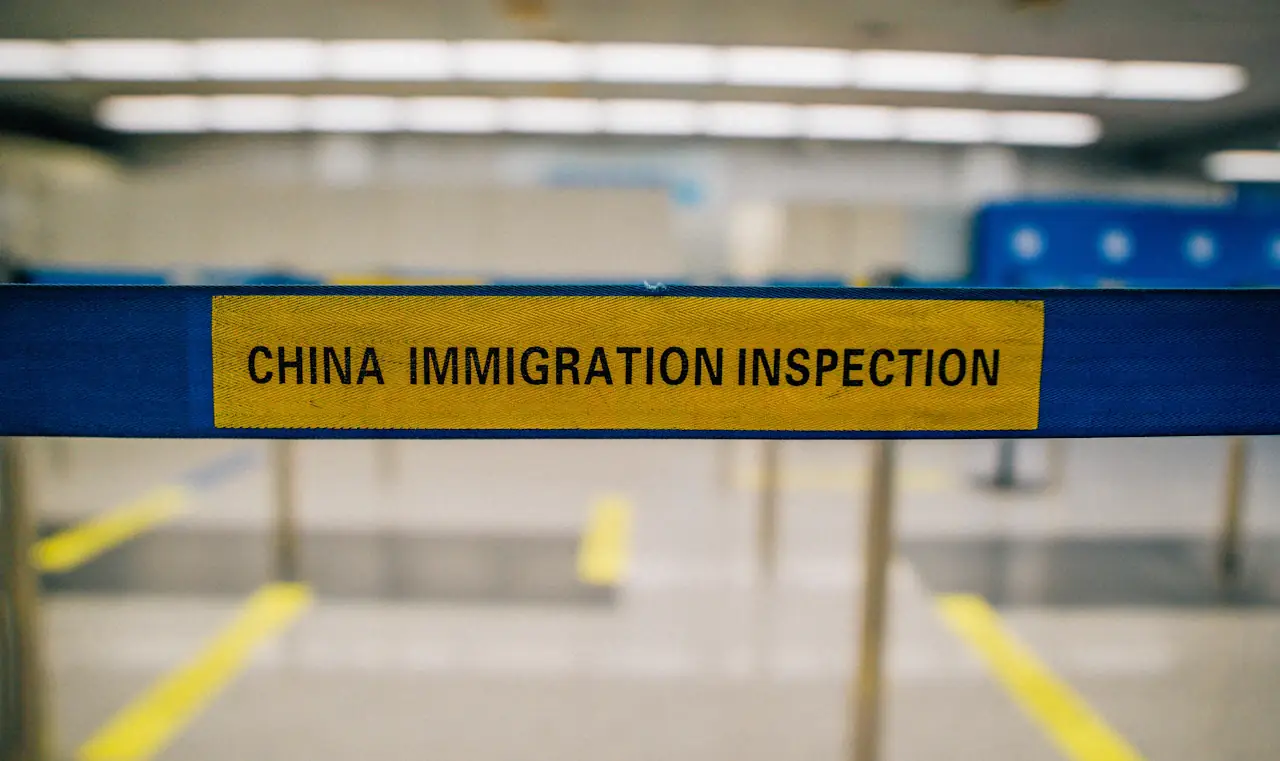
Short answer: Each person may carry RMB 20,000 in cash into or out of China, whatever their nationality or age. Foreign-currency cash above USD 5,000 (or its equivalent) must be declared in writing when you enter. On the way out, you need no permit if you carry no more foreign cash than you declared at your last entry; otherwise up to USD 5,000 needs no permit, and more than USD 5,000 up to USD 10,000 needs a bank permit. Take the red channel if you carry anything on the declaration list below.
Cash limits: RMB 20,000 and USD 5,000
Replies from Shijiazhuang Customs (2023-11-27) and Jiangmen Customs (2026-09-07) say the same thing: Chinese citizens and foreigners may each carry RMB 20,000 per trip, entering or leaving, with no age limit. "More than" does not include the number itself (Customs Order No. 276, Art. 36), so exactly RMB 20,000 is not over the limit.
| Entering China | Leaving China | |
|---|---|---|
| RMB cash | RMB 20,000 per person per trip | RMB 20,000 per person per trip |
| Foreign-currency cash, up to USD 5,000 equivalent (inclusive) | No declaration needed under this rule | No Carrying Permit needed |
| More than USD 5,000, up to USD 10,000 (inclusive) | Declare to Customs in writing | Carrying Permit from a designated foreign-exchange bank |
| More than USD 10,000 | Declare to Customs in writing | Not allowed in principle; five special cases can apply to the SAFE branch where your deposit or purchase bank is |
The entry rule comes from the State Administration of Foreign Exchange (SAFE) Guangdong branch Q&A, a page from 2018 by its web address. The exit rule comes from the Provisional Measures on Carrying Foreign-Currency Cash In and Out (Huifa [2003] No. 102), posted on the SAFE Tianjin site (2024-04-30).
Leaving with foreign cash. If you carry no more than you declared at your last entry, you need no permit, and Customs releases you on that record (Shijiazhuang reply). The exit tiers apply if you have no such record or carry more than it. Details:
- The Carrying Permit SAFE approves for more than USD 10,000 is valid for 30 days and nationwide (SAFE Qingdao service guide, posted 2025).
- Several bank-stamped permits that add up to more than USD 10,000 are not released (Jiangmen reply).
- The five special cases for more than USD 10,000 are large outbound groups, long scientific expeditions, government leaders on visits, travel to a country at war, with strict exchange controls, poor financial conditions or financial turmoil, and other special cases. For individuals, the Qingdao guide's only condition is a real need to carry more than USD 10,000 to such a country or region. It lists a written application, copies of your passport or other exit document and valid visa or endorsement (none for visa-free or visa-on-arrival destinations), proof of the cash source and proof of need, with no fee, a decision normally within 20 working days of acceptance (an approved extension can add 10 working days) and one visit in person.
Frequent crossers. If you leave or enter more than once in a day, or more than once within 15 days, your first entry follows the USD 5,000 rule. From the second entry on, you must declare foreign cash whatever the amount (SAFE Guangdong). The Shijiazhuang reply excludes frequent crossers from the exit tiers above but does not say what applies to them instead.
More than RMB 20,000. Customs requires a written declaration for currency cash above the prescribed amount (Announcement 2025 No. 43). RMB and foreign currency are on the restricted-articles list, so they must meet the quota and carry the required permits (Order 276, Art. 6). The Jiangmen and Shijiazhuang replies give no release procedure and no fine amount. Call the Customs 12360 hotline before you travel with an amount near the limit.
What you must declare
Order 276 (published 2025-02-17, effective 2025-04-01) and Customs Announcement 2025 No. 43 (dated 2025-03-31, effective 2025-04-01) list the cases that need a written declaration. Announcement 43 repealed Announcement 2007 No. 72, so that notice's declaration lists no longer apply.
| Situation | Entering | Leaving |
|---|---|---|
| Prohibited articles | Declare | Declare |
| Restricted articles above the quota, or needing a permit or other papers | Declare | Declare |
| Animals, plants, animal or plant products, other quarantine items | Declare | Not on the list |
| Blood and other human tissue, pathogens, biological products, or items contaminated by or risking spread of a quarantine disease | Declare | Declare |
| Currency cash above the prescribed amount | Declare | Declare |
| Goods above the duty-free amount or quantity limit | Declare | Not on the list |
| Commercial goods, samples, advertising items; other items the law says must be declared | Declare | Declare |
| Baggage sent separately | Declare | Not on the list |
Customs allows a reasonable quantity for personal use: private use or gifts to relatives or friends, in a normal amount for the purpose and length of your stay (GACC English page). Amounts beyond that are handled as goods (Order 276, Art. 5).
Red channel, green channel and the form
- Check the table above. If anything applies, or you are unsure, use the red channel (Order 276, Art. 12). The green channel needs no form if you carry nothing that needs a written declaration (Announcement 43, points 1 and 2).
- Fill in the paper baggage declaration form. Or pre-fill the electronic data in the WeChat or Alipay mini-program "Customs Entry-Exit Persons Fingertip Service", or on a web page.
- At the declaration desk, show your valid entry-exit document, hand over the paper form or confirm the electronic data, and submit permits and other papers.
- Complete the declaration before Customs starts an inspection, or it counts as not declared (Art. 11). Customs can inspect baggage in either channel. Tell Customs first if an item is fragile or could hurt someone (Art. 15).
Items you take out and bring back. Order 276, Art. 13 lets you register temporary items with Customs in writing and provide security; on return Customs releases the items on that record. Order 276 does not say how the security is paid or which documents to bring.
Transit passengers. If you stay inside the Customs-controlled area, you can skip the baggage form, but you may not carry prohibited articles unless the competent authority approves, or leave baggage in China without Customs' agreement. If you are allowed out of that area, Customs treats you as an entering passenger (Art. 30 and 31).
Duty-free allowances for arrivals
The Measures for Collecting Customs Duty, VAT and Consumption Tax on Inbound Articles took effect on 2024-12-01 (Ministry of Finance PDF). Customs Announcement 2024 No. 176 (dated 2024-11-29) aligns the declaration rules.
| Traveller | Duty-free value |
|---|---|
| Resident arriving from abroad (returns to a usual home in China) | RMB 5,000 inclusive, for personal-use goods bought abroad |
| Non-resident visitor (returns to a home abroad) | RMB 2,000 inclusive, for goods meant to stay in China |
| Resident aged 18 or over arriving from Hong Kong or Macao | RMB 12,000 inclusive (Nanjing Customs page) |
| Entering more than once within 15 days, or under 18 | Only items necessary for the trip |
| Airport with an arrival duty-free shop | Total including shop purchases: RMB 8,000 for residents arriving from abroad; RMB 15,000 for residents aged 18 or over arriving from Hong Kong or Macao (Nanjing Customs page) |
Above your allowance, duty applies only to the excess; an item that cannot be divided is taxed on its full value. Customs bases the taxable value on the actual purchase price and may ask for proof of purchase (Nanjing Customs). Items Customs approved for re-entry do not count toward the allowance (Measures, Art. 12). Duty-free e-cigarettes count toward the goods allowance (Announcement 2024 No. 176).
Tobacco and alcohol. From the allowance table of the Measures. Travellers under 18 get none.
| Item | Arriving traveller | From Hong Kong or Macao | Entering more than once within 15 days |
|---|---|---|---|
| Cigarettes, including heated tobacco | 400 | 200 | 40 |
| or cigars | 20 | 10 | 2 |
| or pipe tobacco | 500 g | 250 g | 40 g |
| E-cigarette devices | 2 | 1 | 1 |
| Pods, or pod-and-device products | 6 | 3 | 1 |
| Total e-liquid | 12 ml | 6 ml | 2 ml |
| Alcohol of 12 degrees or above | 1.5 litres | 0.75 litre | None |
The frequent-traveller column applies once a day.
Prohibited and restricted items
The China Customs single-window page "Prohibited and Restricted Articles" (no date shown) sets these lists.
| Entering China | Leaving China | |
|---|---|---|
| Prohibited | Weapons, replicas, ammunition, explosives; counterfeit currency and securities; printed matter, film, recordings and storage media the page calls harmful to China's politics, economy, culture or ethics; strong poisons; opium, morphine, heroin, cannabis and other addictive narcotics and psychotropic drugs; animals, plants and products carrying dangerous pathogens or pests; food, medicines and other items harmful to human or animal health, from epidemic areas or that can spread disease | Everything prohibited on entry; items containing state secrets; precious cultural relics; endangered and rare animals and plants, including specimens, seeds and propagation material |
| Restricted | Radio transceivers and secure-communication equipment; tobacco and alcohol; endangered and rare animals and plants, including specimens, seeds and propagation material; RMB; other articles restricted by Customs | Gold, silver and other precious metals and products; RMB; foreign currency and securities; radio transceivers and secure-communication equipment; valuable Chinese medicinal materials; general cultural relics; other articles restricted by Customs |
Food, plants and animal products fall under Announcement No. 470 of the Ministry of Agriculture and Rural Affairs and GACC, which lists what you cannot carry in:
- live animals other than dogs and cats; animal carcasses, specimens and waste
- raw or cooked meat, including offal, and meat products
- aquatic animal products (edible sauces made from dried, cooked or fermented aquatic animal products are excluded)
- milk and dairy products, including butter, cheese and condensed milk; eggs and egg products
- bird's nest, except commercially sterile canned nest
- animal fats and oils, hides, raw wool, hooves, bones, horns and their products (some processed craft items excluded)
- animal-source feed, animal-source Chinese medicinal materials and animal-source fertiliser
- fresh fruit and vegetables, fresh-cut flowers, tobacco leaf, and seeds, seedlings and other plant material able to grow
- pathogens, pests, veterinary biological products, cells, organ tissue and blood materials
- soil, organic growing media and genetically modified material
Note 1 on that list exempts items approved by the competent authority that carry a quarantine certificate issued by an official agency of the exporting country or region. Apart from medicines from epidemic areas or that can spread disease, the single-window page does not list personal medicines as a category.
Airport security: liquids, power banks, lighters
Security screening is not Customs. These rules come from CAAC.
| Item | Carry-on | Checked bag |
|---|---|---|
| Liquids, international or regional flight from a Chinese airport | Containers of 100 ml or less each, in one resealable transparent bag of 1 litre maximum, one bag per passenger. The bag is screened separately. | Allowed |
| Liquids, domestic flight | Not allowed, except one of each kind of cosmetics for personal use during the journey in containers of 100 ml or less (opened for inspection); one item each of toothpaste and shaving cream of 100 g (ml) or less; liquid dairy products that infant passengers need during the journey and liquid medicine that passengers with diabetes or other illnesses need during the journey, after screening | Allowed |
| Alcohol | Not allowed | Clearly labelled, in retail packaging, each container 5 litres or less. 24% or less: no quantity limit. Above 24% up to 70%: 5 litres per passenger. Above 70%: not carried at all |
| Power banks | 100 Wh or less. Above 100 Wh up to 160 Wh inclusive: airline approval, maximum 2. Above 160 Wh: not allowed | Never |
| Lighters, matches | Not allowed | Not allowed |
| E-cigarettes | Allowed | Not allowed |
The 100 ml limit applies to the container, not to what is inside it (CAAC air travel guide). Battery labels must be complete and clear. E-cigarette e-liquid follows the liquid rules, and its battery follows the power bank rules.
Duty-free liquids. CAAC's liquids announcement (dated 2007-03-17, in force from 2007-05-01) and its air travel guide say: keep the receipt and the sealed transparent bag, and do not open it. Tell the seller your stops and destination, as foreign airports may have their own rules. On a connection from an international flight within the same Chinese control area, the liquids must be in an intact sealed bag, with the receipt, and pass security. If you leave the control area for a domestic connection, they must go in checked baggage.
The air travel guide says alcohol cannot go in carry-on, and also says liquids bought in the airport control area or on board may be carried until you leave the control area. It does not say how that applies to sealed duty-free spirits. Ask your airline before you buy spirits for the cabin.
Power banks on domestic flights. Since June 28, 2025, passengers may not carry power banks without a 3C (CCC) mark, with an unclear mark, or from recalled models or batches (CAAC urgent notice, news item of 2025-06-26). CAAC's 2015 notice (dated 2015-08-14) also bans using a power bank in flight and carrying power banks for purposes other than personal use.
Bringing a dog or cat into China
Customs Announcement 2019 No. 5 (published 2019-01-02, effective 2019-05-01) sets the rules, with details from the Beijing and Hangzhou Customs pages.
- What: only dogs and cats, one per person per entry. The announcement bans any other live animal.
- Papers: an official quarantine certificate from the exporting country or region, a rabies vaccination certificate and a microchip. For pets from designated places, Hangzhou Customs says the certificate must show an official clinical check within 14 days before arrival. Beijing Customs also lists your passport, and a pick-up slip (提货单) for checked pets. Submit paper originals; Customs keeps a copy. At entry, you also fill in the Registration for Pet Dogs and Cats Carried by Passengers form.
- Quarantine: 30 days at a Customs-designated site by default, and detention time counts. Beijing Customs lists the inspection as free of charge but states no boarding costs.
- Quarantine-free entry, after a passed on-site check, in three cases:
- The pet comes from a designated country or region and has a valid microchip.
- The pet comes from any other place, has a microchip and has a rabies antibody report of at least 0.5 IU/ml from a laboratory Customs accepts. Hangzhou Customs says the blood draw must be on or after the pet's second rabies vaccination, and the report is valid for one year from the blood draw; the result stays valid if the pet gets another rabies vaccination before its current one expires.
- The animal is a guide, hearing or search-and-rescue dog with a microchip, proof of use and proof of training.
- Designated places (Hangzhou Customs page): New Zealand, Australia, Fiji, French Polynesia, Hawaii (US), Guam (US), Jamaica, Iceland, the UK, Ireland, Liechtenstein, Cyprus, Portugal, Sweden, Switzerland, Japan, Singapore, Hong Kong and Macao. The announcement says GACC's published lists prevail.
- Ports: pets needing quarantine must enter through a port with quarantine facilities. Hangzhou Customs lists 10, including the airports at Beijing Capital, Shanghai Pudong, Guangzhou Baiyun and Urumqi Diwopu.
- If the rules are not met (more than the limit, no valid quarantine or rabies vaccination certificate, entry through a port without quarantine facilities when the pet needs quarantine, or failed quarantine): Customs returns the pet within a deadline or destroys it. A guide, hearing or search-and-rescue dog that lacks only the vaccination certificate can be vaccinated at a qualified institution on request.
- Flying with a pet: small animals normally cannot travel in the cabin unless the airline allows it. To check a pet, you need a valid animal quarantine certificate, a dedicated container that meets air transport requirements and airline approval (CAAC air travel guide).
- Leaving with a pet: declare to local Customs within 7 days before departure. Customs checks papers, examines the pet and issues an Animal Health Certificate. Bring a valid rabies vaccination certificate, your exit document and any microchip or antibody report the destination asks for (Hangzhou Customs).
Arrival card and visa-free transit
Arrival card. The National Immigration Administration (NIA) started a free online arrival card service for foreigners on 2025-11-20. The NIA page of 2025-12-05 names the official channels (the NIA website, government service platforms, "NIA 12367", mini-programs and a designated QR code), warns that fake websites charge fees, and gives s.nia.gov.cn/ArrivalCardFillingPC as the official address. If you cannot submit in advance, you can fill in the card on smart devices at the port, and paper cards remain available. The page does not say who must complete a card.
Visa-free transit (NIA page dated 2026-08-20):
| 24-hour transit | 240-hour transit | |
|---|---|---|
| Who | Nationals of all countries | Nationals of 57 countries |
| Ports | All open exit-entry ports | 65 open ports in 24 provinces, autonomous regions and municipalities |
| Documents and ticket | Valid international travel documents and an onward international flight, ship or train ticket with a confirmed seat, to a third country or region | Ordinary passport and an onward ticket with a confirmed seat and departure date, to a third country or region |
| Stay | Up to 24 hours, without leaving the port's restricted area; leaving it needs a temporary entry permit from port immigration | Up to 10 days, in the permitted areas |
| Activities | None named | Travel, business, visits, family reunions; work, study and news reporting need prior approval and a visa |
The 57 countries on the NIA page: Albania, Austria, Belarus, Belgium, Bosnia and Herzegovina, Bulgaria, Croatia, Cyprus, Czech Republic, Denmark, Estonia, Finland, France, Germany, Greece, Hungary, Iceland, Ireland, Italy, Latvia, Lithuania, Luxembourg, Malta, Monaco, Montenegro, the Netherlands, North Macedonia, Norway, Poland, Portugal, Romania, Russia, Serbia, Slovakia, Slovenia, Spain, Sweden, Switzerland, Ukraine, United Kingdom, Canada, United States, Argentina, Brazil, Chile, Mexico, Australia, New Zealand, Brunei, Indonesia, Japan, Kyrgyzstan, Qatar, Singapore, South Korea, United Arab Emirates and Vietnam.
The list of eligible ports and permitted stay areas on that NIA page is an image. Read it on the NIA visa-free transit page.
Need flights or a hotel quote?
Planning a trip to or from China? Send us your travel dates for a quote: contact us.