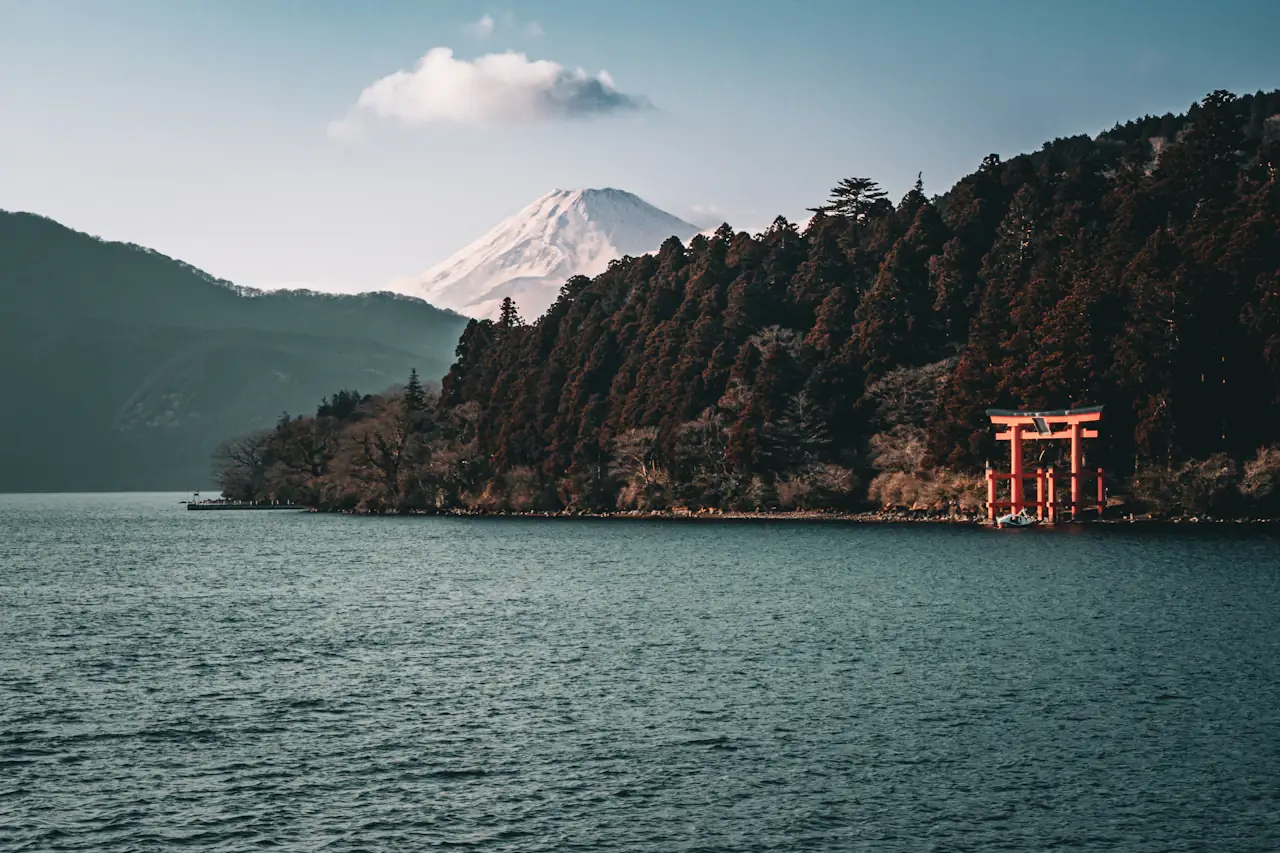
Choose the Fuji Five Lakes (Fujigoko) if seeing Mount Fuji is the point of the trip, and base yourself at Lake Kawaguchi. Choose Hakone if you want a hot-spring trip with museums, a lake cruise and a ropeway, and treat Fuji as a bonus. The official pages point the same way. Yamanashi's tourism guide describes "ubiquitous and unrivaled views" of the peak around the lakes, while Hakone's tourism association says some of the mountains around Hakone block direct views of Fuji.
Neither side publishes clear-day odds. Both sides' official pages say winter gives the clearest Fuji, and JNTO adds that mornings are better at Lake Kawaguchi. Beyond that, it is weather luck.
Hakone and Fuji Five Lakes side by side
| Hakone | Fuji Five Lakes (Kawaguchiko base) | |
|---|---|---|
| Fuji views | Many spots: Owakudani, the Lake Ashi shore at Moto-Hakone, Mt. Kintoki, the ropeway, the lake cruise. Nearby mountains block some direct views | Lakeshores, Chureito Pagoda, the north side of Lake Kawaguchi in the morning |
| What else is there | Hot springs, art museums, Owakudani volcanic vents, Old Tokaido Road walks | Lakes, hot springs, museums, Fuji-Q Highland, lava caves, Oshino Hakkai |
| From Shinjuku | Romancecar, about 80 minutes to Hakone-Yumoto | Highway bus just under 2 hours; Fuji Kaiyu limited express, fastest 1 hour 53 minutes |
| Clearest season | Winter (Odakyu) | Winter (JNTO) |
| Suggested length | Odakyu's samples: a day trip, or one night and two days | JNTO's itinerary: 3 days |
| Pass | Hakone Freepass | Fuji Hakone Pass (covers both areas) |
Which should you choose
- Fuji is the main goal, and you have one or two nights: Fuji Five Lakes. Sleep near Lake Kawaguchi so you can be on the north shore in the morning, because JNTO says haze and clouds tend to build later in the day.
- You want onsen, museums and a scenic loop, and Fuji is a nice extra: Hakone. Its own tourism association says the mountains block some direct views, so treat a Fuji sighting as a bonus rather than the plan.
- You are visiting in winter: either works. JNTO calls winter the best time to see Fuji clearly from Lake Kawaguchi, and Odakyu says Fuji looks exceptionally clear from Hakone in winter.
- You have a JR Rail Pass: the Fujikyu Line to Kawaguchiko does not accept it (JNTO). For Hakone, hakone-japan says a JR Rail Pass holder can ride the Tokaido Shinkansen and change trains at Odawara.
- You have only one day: Hakone has the shorter direct ride from Shinjuku, about 80 minutes to Hakone-Yumoto. The official pages do not give a total time to reach the far sights such as Lake Ashi or Owakudani.
- You have three days or more: combine both with the Fuji Hakone Pass, or do Five Lakes alone at the 3-day pace JNTO suggests.
Getting there from Tokyo
To Hakone
The Odakyu Romancecar runs from Shinjuku to Hakone-Yumoto in about 80 minutes. All seats are reserved. The Romancecar page lists 1,200 yen for adults and 600 yen for children one way to Hakone-Yumoto, on top of the regular train fare, with a timetable dated 14 March 2026.
Hakone-japan.com says the train takes between 50 and 90 minutes depending on which train you pick. It also lists the Shinkansen to Odawara followed by a short train ride of about 15 minutes to Hakone-Yumoto, and direct express buses from Shinjuku to Sengokuhara in about 2 hours.
To Lake Kawaguchi
| Route | Time | Fare |
|---|---|---|
| Fuji Kaiyu limited express, direct Shinjuku to Kawaguchiko | Fastest 1 hour 53 minutes | Fujikyu's Fuji Kaiyu page lists 4,200 yen one way (basic fare 2,580 + limited express 1,620) |
| Highway bus, Shinjuku Expressway Bus Terminal to Kawaguchiko Station | Just under 2 hours; JNTO's itinerary says about 1 hour 45 minutes | JNTO's itinerary lists 2,000 yen |
| JR Chuo Line to Otsuki, then Fujikyu Line | About 1 hour to Otsuki; 2 hours 5 minutes in total per JNTO's itinerary | Otsuki to Lake Kawaguchi is 1,170 yen on Fujikyu's fare table; the JR section is not given |
Fuji Kaiyu runs four round trips a day, with one more in some seasons, and the timetable on that page runs from 14 March 2026. The JNTO bus and train figures carry no date, so treat them as guides and not current fares.
Between Otsuki and Kawaguchiko, Fujikyu describes its Fujisan View Express as taking approximately 45 minutes, but the timetable on the same page (effective March 14, 2026) shows 49 to 60 minutes depending on the train. It lists two of these trains each way a day: from Otsuki at 10:49 and 14:57, and from Kawaguchiko at 9:16 and 13:02. Fujikyu also runs a daily JR direct train between Tokyo and Kawaguchiko with no transfer, but only two trains each way. The Kawaguchiko to Tokyo train leaves in the morning and the Tokyo to Kawaguchiko train in the evening, so it does not suit a morning start from Tokyo.
Hakone Freepass and Fuji Hakone Pass
Hakone Freepass
The fares below are in effect from 1 October 2025, according to Hakone's Freepass page, and match Odakyu's Freepass page. Child fares apply to ages 6 to 11.
| Departure | 2-day adult / child | 3-day adult / child |
|---|---|---|
| Shinjuku | 7,100 / 1,600 yen | 7,500 / 1,850 yen |
| Odawara (Hakone only) | 6,000 / 1,500 yen | 6,400 / 1,750 yen |
- Odakyu Line: the version from Shinjuku includes one Odakyu Line round trip between Shinjuku and Odawara. The Odawara version does not include an Odakyu ticket.
- Rides: unlimited use of eight kinds of Hakone transport: the Hakone Tozan Railway, Tozan Cable Car, Hakone Ropeway, Hakone Sightseeing Cruise, and the Hakone Tozan Bus, Odakyu Highway Bus, Tokai Bus and "Kanko Shisetsu-Meguri" sightseeing bus in designated areas.
- Discounts: at about 70 facilities.
- Romancecar: needs a separate limited express ticket, 1,200 yen for adults one way from Shinjuku. Odakyu's own example for a Shinjuku round trip is 7,100 yen for the 2-day pass plus 2,400 yen for the round-trip Romancecar, which it totals as 9,500 yen.
- Gotemba bus: with the Freepass from Shinjuku, the Odakyu Highway Bus between Shinjuku and Gotemba is 1,000 yen, against a regular adult fare of 2,000 yen (Hakone's Freepass page).
- Validity: the purchase date counts as day one, and Odakyu notes that a 2-day pass does not mean 48 hours: it ends after the last train or bus service on the second day.
Fuji Hakone Pass
According to Odakyu's Fuji Hakone Pass page, the pass is valid for 3 consecutive days and costs 11,100 yen for adults and 3,600 yen for children. The page carries no effective date. It includes discounts at over 70 spots in Hakone, including hot springs, museums and restaurants, plus:
- a discounted Odakyu round trip between Shinjuku and Odawara
- the same Hakone transport as the Freepass
- the entire Fujikyu Railway (Otsuki to Kawaguchiko)
- Fujikyu Bus in designated areas around Mount Fuji
It does not cover the JR Chuo Line from Shinjuku to Otsuki, the highway bus from Shinjuku to Kawaguchiko Station, Fujikyu Highland or Mt. Fuji Station, or the Odakyu Highway Bus from Shinjuku to Tomei-Gotemba. It is sold only as a paper ticket at the Odakyu Sightseeing Service Center Shinjuku West or Odawara, not online or from vending machines. The Romancecar again needs its own ticket.
Where the Fuji views are
Hakone
- Owakudani and the Lake Ashi shore at Moto-Hakone: hakone-japan.com names Owakudani among the best views, and says the Moto-Hakone shore with the Hakone Shrine torii gate in the picture is a beautiful view too. Odakyu describes the large torii as appearing to float on Lake Ashi.
- Mt. Kintoki, Sengokuhara: climbing it gives one of the best views of Fuji in Japan, according to hakone-japan.com.
- Komagatake Ropeway: takes you up one of Hakone's highest peaks for views of Fuji, the Pacific Ocean and a mountaintop shrine (hakone-japan.com).
- Hakone Ropeway and Lake Ashi cruise: Odakyu lists both, plus hotel gardens, as Fuji viewpoints. The ropeway from Sounzan to Togendai is about 4 km and takes about 30 minutes one way. The cruise from Moto-Hakone to Togendai takes about 30 minutes. Both are covered by the Freepass.
- Hotel gardens: Odakyu's Hakone page describes Hotel de Yama's lakeside park with 3,000 azaleas looking out to Fuji, in bloom from early to mid-May.
Fuji Five Lakes
- North side of Lake Kawaguchi: JNTO suggests going early to the north side. On a still, clear day Fuji reflects in the lake.
- Chureito Pagoda, Arakurayama Sengen Park: 15 minutes on foot from Shimoyoshida Station according to Fujikyu, or about 400 steps according to Odakyu. JNTO calls the pagoda-and-Fuji shot the most sought-after photo in the Fujigoko area.
- Lake Motosuko, north shore: the view that appears on the 1,000 yen bill (JNTO).
- Lake Shojiko: the reflection of Fuji here is known as the Upside-down Fuji, and JNTO points to the Eboshi-dake Panorama Platform on the southwest side.
- Lake Yamanakako: the closest of the five lakes to Fuji, according to Yamanashi tourism. Its Panorama-dai lookout sits at 1,090 meters, and Yamanashi says its sunrise and sunset views are remarkable year-round.
- Around Fujisan Station: Fujikyu's map lists the observation deck on the 6th floor of the Q-Sta terminal building and the Kanatorii torii, 5 minutes on foot from the station.
Best time to go and crowded dates
Winter is the season both sides' official pages single out for clear Fuji views. It is also cold in Hakone. The Hakone winter page gives average temperatures of 3.4°C in December, 0.4°C in January and 1.7°C in February, measured at Hakonemachi, and warns that high ground is colder still.
| When | Hakone | Fuji Five Lakes |
|---|---|---|
| 2-3 January | Hakone Ekiden relay; traffic is restricted in some areas | |
| Late March to mid-April | Cherry blossoms along the Hayakawa River in Miyagino, late March to early April | JNTO lists the Cherry Blossom Festival in mid-April |
| Late April to early May | Golden Week: likely to be crowded | |
| Early to mid-May | Azaleas at Hotel de Yama | |
| June to mid-July | Hydrangeas, early June to mid-July (Odakyu) | JNTO lists lavender from late June to mid-July |
| 10-16 August | Obon: sightseeing areas crowded | |
| Early October to early December | Autumn colour; November is the crowded month | JNTO lists the Autumn Leaves Festival from 1 November through the month |
The crowd dates for Hakone come from the Hakone crowd forecast; the flower seasons come from Odakyu's Hakone page, and the autumn-colour season comes from Hakone's winter page. JNTO gives no year for the Lake Kawaguchi festivals, so confirm them before you book.
How many days, and can you combine both
JNTO's Fuji Five Lakes itinerary recommends 3 days. In Hakone, Odakyu's Freepass samples are a classic day trip and a one-night, two-day stay.
The Fuji Hakone Pass is a 3-day ticket, and its sample itinerary is 3 days and 2 nights across both areas: Owakudani and the Lake Ashi cruise in Hakone, then Oshino Hakkai, Oishi Park and Arakurayama Sengen Park in the Fuji area. The official pages do not give a bus or train time between Hakone and Kawaguchiko, so there is no single through-route time to quote. The Fuji Hakone Pass covers Hakone transport plus Fujikyu Railway and Fujikyu Bus, and the Odakyu Highway Bus only from Tomei-Gotemba to Gotemba Station. Anything else on the way, such as the JR Chuo Line or the Kawaguchiko highway bus, is paid separately.
Where to stay
Hakone is an onsen resort area with traditional inns and hot springs (Odakyu). Hakone-japan.com describes the areas:
- Hakone-Yumoto: the most popular entry point and the last stop on the Odakyu line from Shinjuku or Odawara. Many guests use it as their base.
- Gora: high in the mountains, with many lodging options and restaurants, at the midpoint of the Hakone "Golden Route".
- Moto-Hakone: on the shore of Lake Ashi, small and pedestrian friendly.
- Sengokuhara: highland hot springs, reached by bus, and the starting point for Mt. Kintoki.
Lake Kawaguchi is the main entry point to the Fuji Five Lakes and, according to Yamanashi tourism, is well developed for visitors, with many lakeside hotels, hot springs and excursion boats. Lake Yamanakako, the largest of the five lakes, is another option: JNTO says it has a handful of hotels and inns, and hot springs on the western side with distant Fuji views. Lake Shojiko is less developed, with a few hotels on its north side.
The official pages give no accommodation prices.
Need flights or a hotel quote?
If you are planning flights or a hotel for Japan, contact us with your travel dates and we will send you a quote: Contact us.