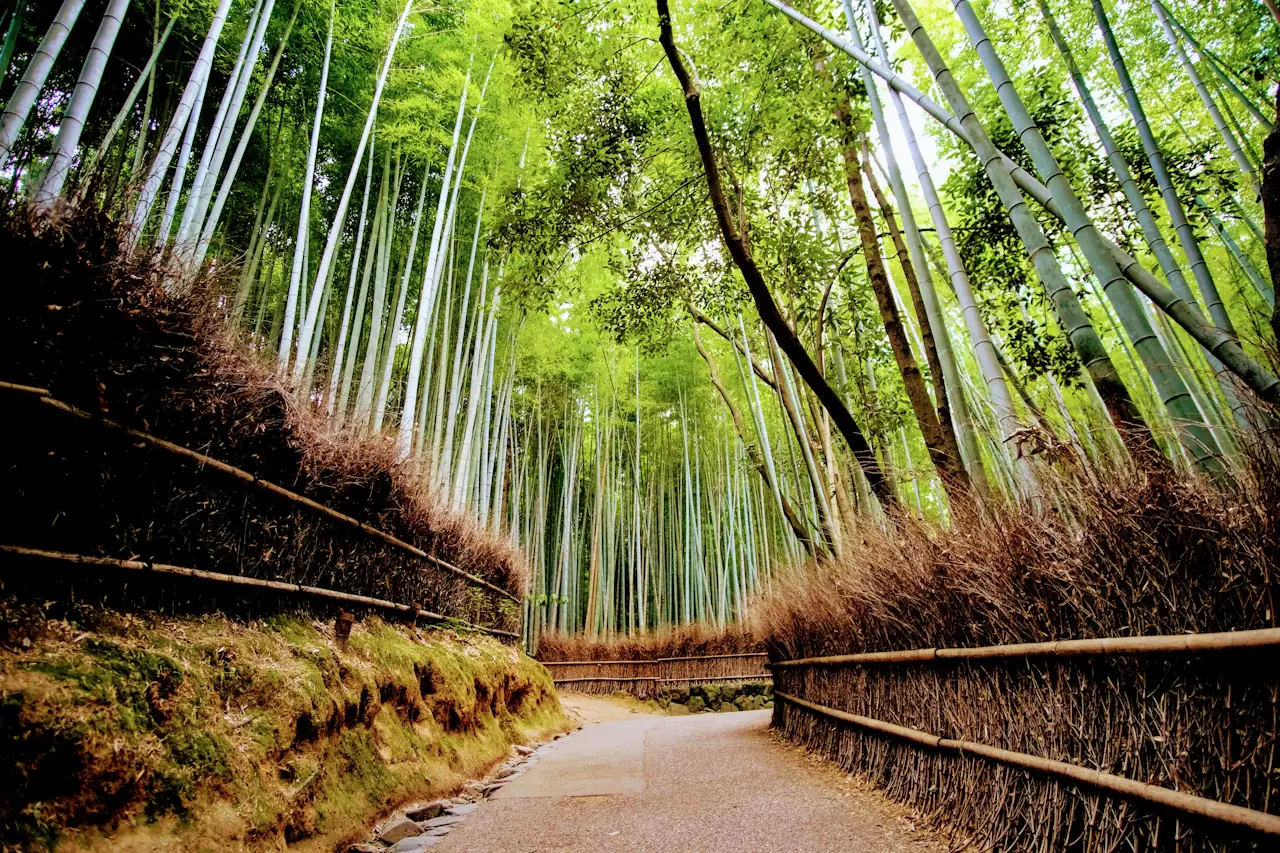
If you want to walk through bamboo, go to Arashiyama. The Japan National Tourism Organization (JNTO) calls the path there "short yet immersive". If you want rows of vermilion torii gates and a climb up a mountain, go to Fushimi Inari Taisha. JNTO says the full mountain tour takes two to three hours. The Fushimi Inari pages cited below, from the shrine, JNTO and Kyoto Travel, describe no bamboo forest. Among the shrine's pages, only the Miyuki Hohaisho page mentions bamboo: black bamboo trees surrounding one prayer area. Both places are in Kyoto, but in different parts of the city: Arashiyama in the west, Fushimi Inari in the south.
The two places side by side
| Arashiyama Bamboo Grove | Fushimi Inari Taisha | |
|---|---|---|
| Part of Kyoto | Sagano, west side of the city | Fushimi, southern Kyoto |
| Best known for | A short, narrow bamboo path | A path of vermilion torii up Mt. Inari (233 m) |
| Nearby | Togetsukyo Bridge, Tenryu-ji | The mountain, the Senbon Torii |
| Train from Kyoto Station | JR Sagano Line to Saga-Arashiyama, about 11 minutes by rapid | JR Nara Line to Inari, 5 or 9 minutes depending on the page |
| Cost to enter | Bamboo path free; Tenryu-ji garden ¥500 (high school students and older), ¥300 (elementary and middle school students), preschool children free | See "Opening hours and fees" below |
| Time on site | No time given; JNTO calls the path short | 2 to 3 hours to tour the mountain (JNTO) |
What each place is
Arashiyama Bamboo Grove. It sits in the Sagano area on the west side of Kyoto. Kyoto Travel (the Kyoto City Tourism Association site) names the Bamboo Grove Road, Togetsukyo Bridge and Tenryu-ji among Arashiyama's attractions. Tenryu-ji's garden leads out of its north gate onto a road where, in the temple's words, you "may walk through the famous Sagano bamboo forest." JNTO suggests approaching the grove from Tenryu-ji's side gate.
Fushimi Inari Taisha. It is the head shrine of the Inari shrines, and the shrine says it was founded in AD 711. Its famous feature is the path of vermilion torii gates up Mt. Inari, which stands 233 m above sea level. The approach to the Okunoin shrine is called the Senbon Torii ("one thousand torii gates"). The sources disagree on the torii count:
- The shrine's FAQ and JNTO say about 10,000 torii along the mountain paths.
- The shrine's Inariyama page says a pathway leads to the top with several thousand red torii along the way.
- The Kyoto Travel page for the shrine says "over 5000".
The sources also disagree on how many Inari shrines there are in Japan. The shrine's FAQ and JNTO say around or over 30,000. The Kyoto Travel page says some 40,000.
Is there a bamboo forest at Fushimi Inari?
The Fushimi Inari pages cited here (the shrine's FAQ, Access, Requests, Inariyama, Senbon Torii and Miyuki Hohaisho pages, plus JNTO and Kyoto Travel) do not describe a bamboo forest. They describe the torii path and the mountain. Of the shrine's pages, only the Miyuki Hohaisho page mentions bamboo: this prayer area opened in 1963 and "is surrounded by black bamboo trees." The page describes bamboo around one prayer area on the mountain ridge, not a bamboo path. For bamboo, use Arashiyama. For torii gates, use Fushimi Inari.
How to get there by train
Arashiyama
| Route | Time and fare | Walk at the end |
|---|---|---|
| JR Sagano Line to Saga-Arashiyama Station | About 11 minutes by rapid; rapid and local trains stop there | About 8 minutes to the Togetsukyo Bridge area (Kyoto Travel); 10 minutes to the grove (JNTO); 13 minutes to Tenryu-ji (Tenryu-ji) |
| Subway Karasuma Line to Karasuma Oike, Tozai Line to Uzumasa Tenjingawa, then Randen to Arashiyama Station | Subway about 20 minutes, adult ¥260; Randen about 15 minutes, adult ¥250 (as listed on the Kyoto Travel page dated November 2022) | About 4 minutes to Togetsukyo Bridge (Kyoto Travel); 5 minutes to Tenryu-ji (Tenryu-ji) |
| Hankyu Kyoto Line from Hankyu Kyoto-Kawaramachi to Katsura, change to the Arashiyama Line, last stop Arashiyama Station | Not given | A short walk to Togetsukyo Bridge (Hankyu); 15 minutes to Tenryu-ji (Tenryu-ji) |
The walking times differ because each page measures to a different point: the bridge, the grove or Tenryu-ji. Kyoto Travel's access page also warns that the Sagano Line platform at Kyoto Station is further away than other lines, and that the JR line is fast but crowded. It suggests the subway and Randen route as the alternative. The subway and Randen fares and times date from 2022 and may have changed.
Fushimi Inari
- JR Nara Line to Inari Station. The shrine's Access page says "2 stations/5 minutes from Kyoto Station" and that the shrine is right next to Inari Station. Kyoto Travel says about 9 minutes for the same trip. It adds that all rapid and local trains stop at Inari Station. The two pages give different numbers.
- Keihan Main Line to Fushimi-Inari Station. The shrine says 5 minutes on foot; Kyoto Travel says about 5 minutes; JNTO says about 7 minutes. From Keihan Gion-Shijo Station the ride is about 22 minutes, and limited express trains do not stop at Fushimi-Inari Station (Kyoto Travel).
- By car. The shrine recommends public transport because the parking areas around it are very crowded.
Opening hours and fees
Tenryu-ji (Arashiyama). Tenryu-ji's Admission and Access page lists:
| Item | Detail |
|---|---|
| Hours | 8:30 to 17:00, last admission 16:50 |
| Garden only | High school students and older ¥500; elementary and middle school students ¥300; preschool children free |
| Garden plus buildings | The same fee plus ¥300 |
| Closings | Buildings are occasionally closed without notice for ceremonies and other activities. Scheduled closings for 2026 are April 1 from 12:30, and October 29 and 30; the page does not say whether these cover the garden or only the buildings |
Tenryu-ji has a car park that does not take reservations.
The bamboo path. The Hankyu Railway page for the Arashiyama course says entry to the Bamboo Grove is free and you can walk at your own pace. You have two ways in. You can walk to the path directly, which is free. Or you can pass through the Tenryu-ji garden and leave by its north gate, which means paying the garden fee. The JNTO and Hankyu pages give no opening hours for the grove.
Fushimi Inari Taisha. The shrine's Access, FAQ and Requests pages on inari.jp list no opening hours or admission fee for the grounds. Check inari.jp for the current information.
How long it takes
- Mt. Inari. JNTO says it takes two to three hours to tour the mountain, with a souvenir shop and tea stall about halfway up. It recommends a visit from late morning to mid-afternoon. Kyoto Travel calls the walk around the upper precincts a "pleasant day hike" but gives no time.
- Arashiyama bamboo path. The JNTO and Hankyu pages give no walking time for the path itself. JNTO says only that it is short. The times you can plan with are the station-to-place walks in the table above.
Crowds and when to go
Kyoto Travel runs a Congestion Forecast that covers both the Arashiyama Bamboo Forest and Fushimi-Inari Taisha. It shows congestion on a 5-point scale by date and time, and you can choose sunny, rainy or heavy rain. It also links to live cameras. Predictions are updated periodically and become more accurate as the day gets closer.
Two official notes stand out:
- Fushimi Inari. A Kyoto Travel news item dated January 30, 2025 said the area around the shrine was heavily crowded and pointed readers to the forecast.
- Arashiyama. Kyoto Travel says the area always draws large numbers of visitors for its cherry blossoms and fall foliage. It recommends going early in the morning and taking the less crowded route through Kameyama Park to the Bamboo Grove Road.
Use the forecast to compare dates and times for your own visit. The forecast page says you can avoid the crowds by shifting the time of your visit.
Rules and manners
Both places. Kyoto Travel's basic rules for sightseeing in Kyoto ask visitors not to block the road, not to litter, and to get permission before taking photos or videos. Drone photography is prohibited. Arashiyama and Fushimi Inari Taisha are both among 43 "Beautification Promotion Areas", where those who violate the ordinance can face fines of up to ¥30,000.
Arashiyama. Do not walk onto the train tracks and do not smoke on the street. Knife graffiti has been found on the bamboo, and damaged stalks must be cut down.
Fushimi Inari Taisha. The shrine's requests to visitors (dated January 1, 2022) prohibit, among other things:
- smoking or fires;
- flying drones;
- eating or drinking outside the marked free rest areas, including while walking or standing;
- shouting, or sitting on the ground in ways that cause problems for worshippers;
- bringing pets, except guide dogs and other necessary animals;
- photography for commercial purposes or in prohibited areas;
- taking photographs on narrow paths in a way that keeps worshippers from passing;
- leaving strollers unattended outside marked areas.
People who break these rules will be asked to stop, and to leave if they do not comply.
Can you do both in one day?
The official pages give no time for the whole combination, so there is no clock-time schedule here. These are the numbers to plan with:
- Both trips start from Kyoto Station: about 11 minutes by rapid to Saga-Arashiyama, and 5 or 9 minutes (depending on the page) to Inari Station.
- If you take the two JR routes above, you change between the Sagano Line and the Nara Line at Kyoto Station.
- Mt. Inari takes 2 to 3 hours for the full tour (JNTO). Tenryu-ji is open 8:30 to 17:00, with last admission at 16:50.
A simple way to plan is to choose one as the main stop and fit the other around it. If you have only half a day, the official numbers make Arashiyama's bamboo path the shorter of the two sights.
Which should you choose
| Your situation | Choose |
|---|---|
| You want to walk through bamboo | Arashiyama |
| You want to see torii gates | Fushimi Inari |
| You want a mountain walk | Fushimi Inari (2 to 3 hours for the full tour) |
| You want a Zen garden as well | Arashiyama, with the Tenryu-ji garden |
| You have only a few hours | Arashiyama, because the path is described as short |
| You want the shortest train ride from Kyoto Station | Fushimi Inari (5 or 9 minutes on the two pages) |
| You want to avoid a crowd on your date | Check the Congestion Forecast for both before you decide |
| You have a full day | Both, with one as the main stop |
Planning Kyoto?
If you need hotel or flight quotes for your Kyoto trip, contact us with your dates and we will send a quote on request.